
Organizations scale successfully when teams can move fast without sacrificing quality, engagement, or direction. To achieve this, leadership must cultivate "infrastructure for agency"; building and supporting teams that operate with confidence and make decentralized decisions that advance the organization’s strategic goals.
The TagMe (Targets, Guardrails, Metrics, Examples) framework - devised by Matthew Skelton and colleagues at Conflux - serves as a vehicle for this transformation by enabling teams to define their own KPIs within clear boundaries, harnessing economies of empowerment.

Foster psychological ownership with TagMe
Traditional management often relies on imposing metrics from above and cascading them down the hierarchy. TagMe reverses this flow, encouraging psychological safety by having teams collaborate to identify their own KPIs aligned with organizational objectives. Using a more participatory approach means that teams analyze their work, propose the metrics they believe remain vital to track, and define success on their own terms. This approach creates a deeper sense of ownership, responsibility, and engagement with the overall strategy, resulting in a more cohesive operating model.
The TagMe framework combines four distinct elements, each focused on developing independent decision-making and high-velocity value delivery.
Targets define specific improvements or goals the team aims to achieve over a period, such as maintaining 100% compliance with regulatory reporting or reaching specific service quality thresholds. These targets must provide clear direction for the team's efforts and set reasonable aims over the set period.
Guardrails illuminate the limits of safe operation. By making constraints visible, teams gain a deep understanding of their domain. Guardrails, such as budgets, compliance, or brand standards, act as checks to ensure optimization in one area supports the health of the wider organization. Within these clearly defined boundaries, teams act with authority and autonomy, navigating regulatory landscapes more quickly than competitors.
Metrics provide transparency through dashboards accessible to anyone in the organization. Acting as a window into performance, observers can understand how an area operates without requiring audit or intervention. Effective metrics focus on top-level value indicators, such as task completion rates, operational health, or flow efficiency. This transparency invites collaboration and ensures team alignment with global goals.
Examples clarify the scope of autonomous decision-making through concrete scenarios and guide which decisions a team can make independently and which require consultation. This element builds confidence, allowing teams to perform securely in the knowledge that they are operating within agreed parameters.
TagMe guardrails and metrics in practice
Under traditional models, a typical business activity - such as changing a supplier - often requires layers of approval, slowing progress. With TagMe, teams operate with clearly defined behavioural examples, such as the ability to autonomously change a supplier when the commercial contract terms remain similar.
In this scenario, a Business Operations team evaluates a new legal services provider. Finding that the provider offers equivalent services within the existing budget (guardrail) and improves workflow efficiency (metric), the team proceeds to switch suppliers independently. They act autonomously because the decision falls within the established examples and guardrails. In contrast, a decision involving a substantial tech adoption or significant changes to commercial terms will trigger a consultation under the framework. The team can maintain speed on routine improvements while reserving high-level discussions for strategic shifts.
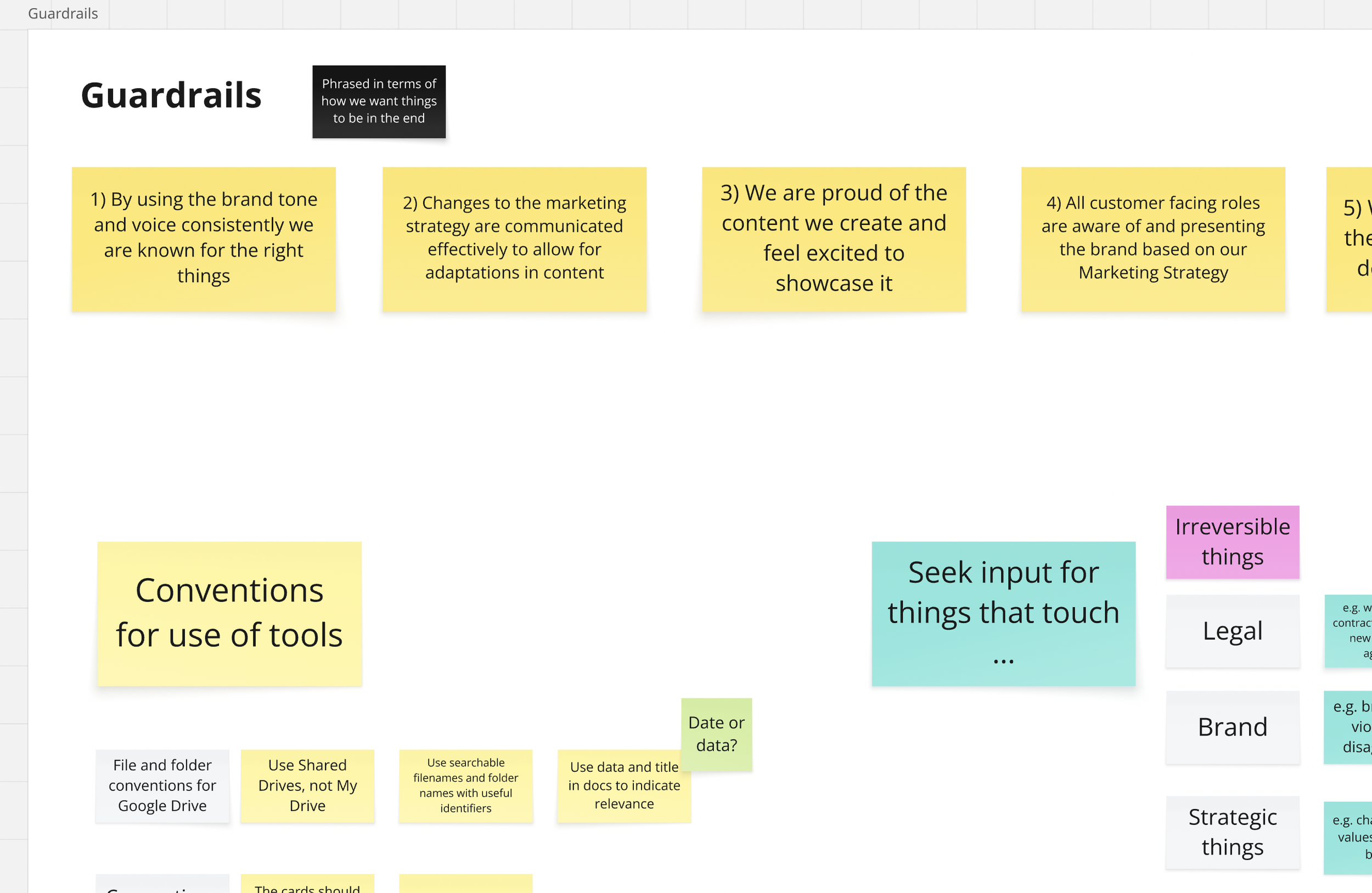
At Conflux, we’ve been using TagMe since 2023. Guardrail mapping exercises, as in the example above, are highly effective for setting out boundaries that enable safe and sustainable autonomy, and are a crucial step in the TagMe process.
How TagMe transforms organizational performance
In order for an organization to thrive, alignment is key. Based on organizational alignment research of 410 companies across eight industries, highly aligned companies:
Grow revenue 58% faster
Are 72% more profitable
Satisfy customers 3.2-to-1
Engage employees 16.8-to-1
Organizations implementing TagMe shift how value flows from strategic vision to customer outcomes, manifesting across several critical areas that distinguish high-performing organizations from those operating under more traditional models. While competitors struggle with misaligned priorities, decision-making bottlenecks, and knowledge silos, organizations adopting TagMe achieve operational agility, deep team engagement, and rapid delivery without sacrificing safety or sustainability.
Economies of empowerment
An organization adopting economies of empowerment can achieve operational agility and high team engagement simultaneously. The TagMe framework is an effective driver of this empowerment, giving teams confidence and reducing the decision latency that often plagues scaling enterprises. Companies can empower teams and reduce time-to-value, while maintaining cost efficiency and team satisfaction.
Compliance as a competitive advantage
Traditionally regarded as blockers, reframing compliance requirements as clearly defined guardrails using the TagMe framework reduces bottlenecks. Teams now have visible safety limits for plotting the fastest route to success and can navigate complex regulatory environments quickly, ensuring the organization moves fast while remaining safe.
Active Knowledge Diffusion
Active Knowledge Diffusion (AKD) is a deliberate, structured approach to spreading knowledge, best practices, and innovations across organizational boundaries. TagMe guides alignment around shared metrics and visible guardrails, encouraging the structured sharing of innovation across boundaries, and supports AKD practices within organizations.
Stewardship of long-lived value streams
The TagMe framework supports a shift from short-term campaigns to ongoing value streams. Teams build deep domain knowledge and maintain the context required to evolve services sustainably, ensuring continuity of care for customers. By visualizing how their specific contribution feeds into larger organizational success, teams act as stewards of long-term outcomes rather than seeking to maximize immediate output.
The ultimate goal of TagMe is to enable aligned autonomy. Teams work independently, yet are confident of their alignment with strategic objectives, removing the disconnect between strategic vision and daily execution. Once teams establish local clarity and ownership, they are ready to align their efforts around a single, organization-wide North Star Metric, ensuring that decentralized decision-making aligns with the overarching organizational strategy.
Build infrastructure for agency in your organization
If you would like to know more about how the TagMe framework aligns teams to make decentralized decisions and how this can drive economies of empowerment in your organization, book a discovery call with our experts.