In 2018, the Immigration Technology Portfolio within the UK Government Home Office Digital, Data, and Technology (DDaT) directorate faced a complex digital engineering challenge: designing, building, and operating software infrastructure governing visa applications, border checks, and right-to-remain processing. The portfolio had to deliver robust software rapidly and safely.
This case study highlights a vital lesson: sustainable delivery uplift cannot be commanded through top-down mandates. Real capability emerges when organizations combine small, essential mandatory standards with Active Knowledge Diffusion, non-punitive capability assessments, and a relentless focus on Continuous Delivery principles.
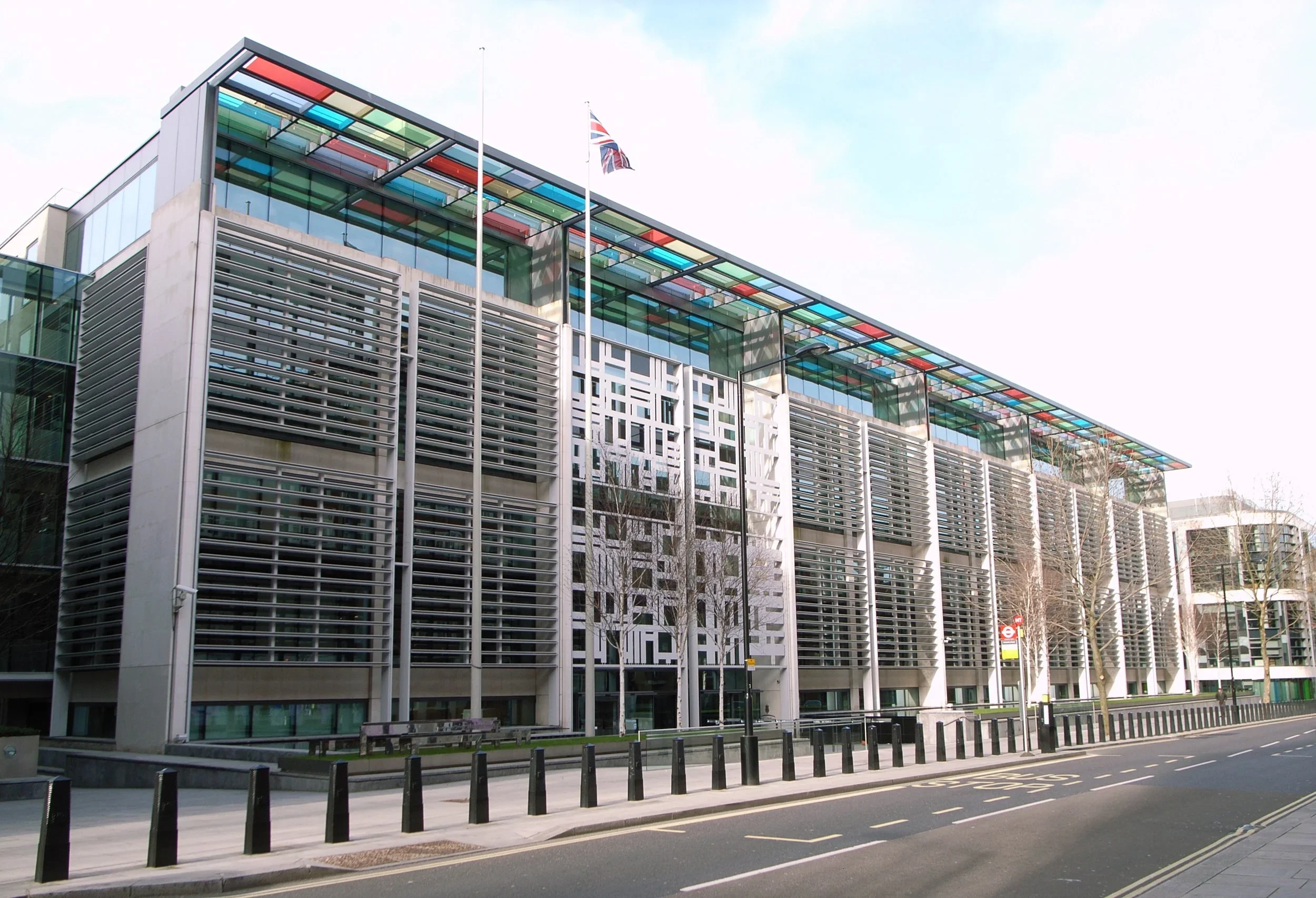
The UK Home Office HQ at Marsham Street, London - via Wikipedia https://en.wikipedia.org/wiki/Home_Office
Key Takeaways:
Establishing Collectively-Curated Shared Standards (CCSS) eliminated operational friction, drastically reduced incident diagnosis time, and transformed support teams' relationship with live services from frustration to enthusiastic adoption.
Active Knowledge Diffusion (AKD) via Engineering Working Groups, Guilds, and "friendly FOMO" successfully scaled engineering practices across a 1,000-person multi-supplier ecosystem and aligned commercial incentives to create a unified community of practice.
Non-punitive Multi-Team Capability Assessments (MTCA) using self-assessment and data anonymization provided leadership with visibility into engineering maturity without triggering fear or gaming of metrics, driving voluntary adoption and targeted enablement.
Continuous Delivery (CD) enablement through automated pipelines, microservice decoupling, and team cognitive load management helped to deliver 30% efficiency savings across the largest program and a 400% increase in software delivery capability on core products.
The challenge of scaling engineering performance under high stakes
In 2018, the UK Government Home Office department faced a complex digital engineering challenge. Within the Digital, Data, and Technology (DDaT) directorate, the Immigration Technology Portfolio was tasked with designing, building, and operating software infrastructure governing visa applications, border checks, and right-to-remain processing. With major legal and political deadlines approaching, most notably the UK's exit from the European Union (aka Brexit), the portfolio had to deliver robust software rapidly and safely.
The operational environment was large and multi-supplier. What began as an initiative of roughly 200 people rapidly expanded into an organization of over 1,000 personnel. Delivery was distributed across more than 70 delivery teams across seven geographical locations, blending civil servants with teams from more than fifteen external consulting and implementation suppliers.
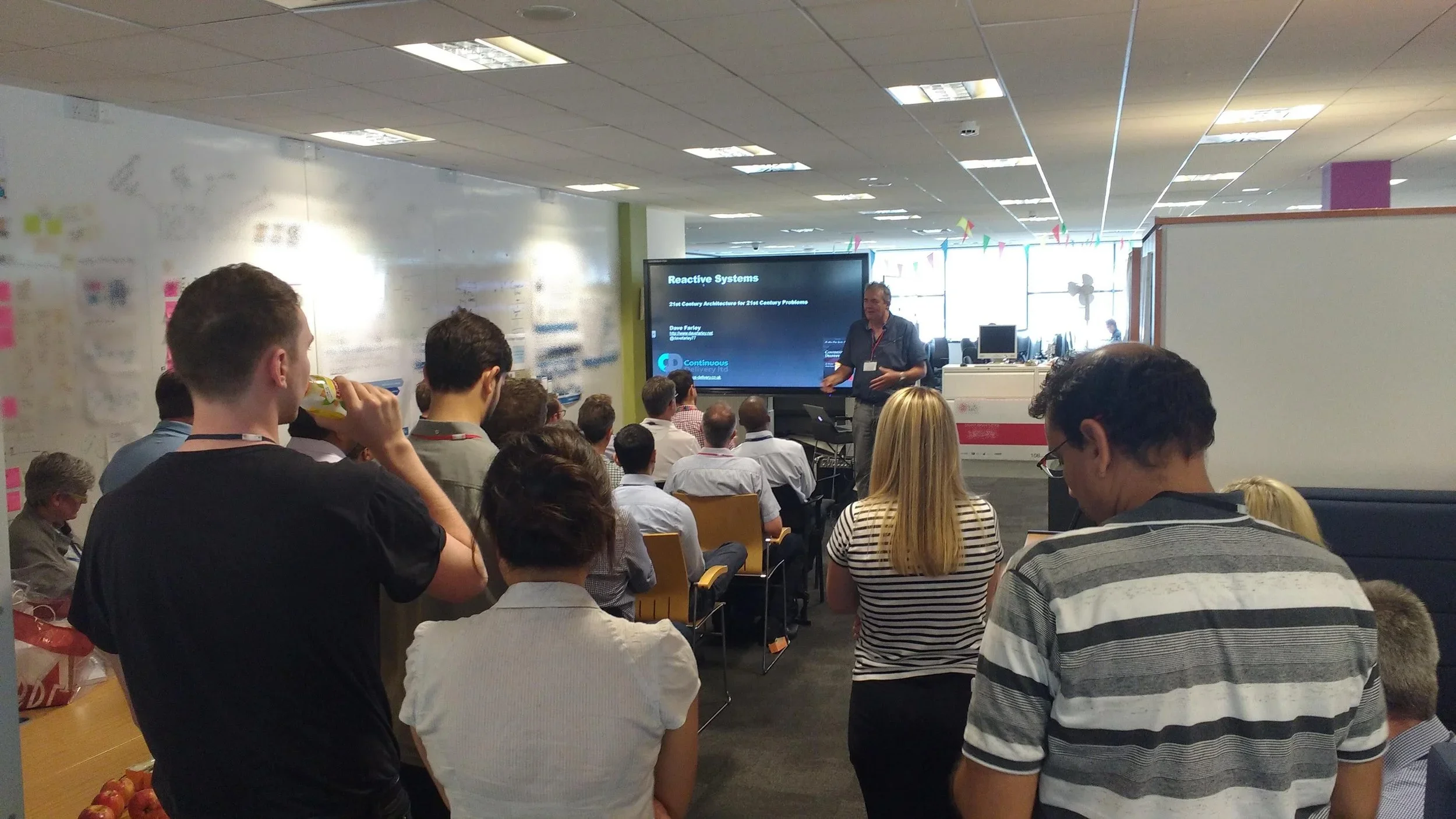
Dave Farley, author of the ground-breaking book Continuous Delivery, giving a lunchtime talk at the Engineering Guild
As the portfolio expanded, leadership encountered a fundamental scaling limit: practices that worked effectively for groups of 15 to 100 people broke down when applied across a 1,000-person multi-supplier ecosystem. Supplier partners brought varying methodologies, tooling assumptions, and architectural conventions. This variance produced macro-level friction: disjointed deployment pipelines, incompatible testing strategies, operational misalignments, and release bottlenecks.
To address these challenges, Conflux partnered closely with Axiologik to improve delivery maturity, establish shared engineering standards, and build organizational capability across the portfolio. Rather than imposing a top-down compliance manual, Conflux and Axiologik introduced a social and technical framework designed to align teams, diffuse effective practices, and enable continuous delivery at scale.
Throughout 2018, I was Engineering Lead for the Immigration Technology program, and I led the detailed practices, techniques, and activities on the ground, together with stakeholder alignment and strategic vision for the engineering capabilities needed.
Read the GOV.UK Home Office Adapt Together case study, where I explore how GOV.UK Home Office achieved alignment and acceleration of digital engineering via shared standards, cross-team assessments, and spotlighting effective practices.
Starting with operator experience: mandatory vs. recommended standards
What I’ve seen time and again is that attempts to scale engineering standards often fail because central architecture committees draft theoretical guidelines detached from daily engineering realities. To establish immediate value in the Home Office program, our work began by focusing directly on the 'operator experience'; working backwards from the daily friction experienced by the support and operations teams managing live systems.
A good illustration of this friction involved application logging. Support teams struggled with live service exceptions. Unstructured and excessive logging traffic from disparate applications had previously caused infrastructure degradation, even overloading centralized logging clusters. More critically, support engineers faced difficulty diagnosing true case-handling exceptions, such as passport or visa processing failures, amid a sea of unstandardized log output.
Upon investigating the root cause, we discovered that supplier teams across the estate were using three different date formats in their log messages. Because tools could not automatically parse or correlate timestamps across microservices, people were forced to spend hours manually reconciling exception timelines.
This scenario highlighted a vital architectural principle: while flexibility is essential, there is zero value in allowing variance for foundational operational interfaces. We instituted a single, mandatory date format standard across all applications. Mandating this standard eliminated unnecessary friction, drastically reduced diagnosis time, and transformed the support teams' relationship with the software from operational frustration to enthusiastic adoption.
Building on this success, Conflux and Axiologik established a framework known as Collectively-Curated Shared Standards (CCSS), structured around a Mandatory-Expected-Recommended model:
Mandatory Standards: A strictly limited set of non-negotiable rules governing essential operational safety and interoperability (such as log date formats and security protocols).
Expected Standards: Core architectural patterns (such as automated deployment pipelines and containerization) that teams were expected to adopt unless a compelling contextual exception existed.
Recommended Standards: A curated 'set menu' of emerging tools, libraries, and techniques tailored to specific technical contexts.
This model explicitly allowed for controlled variation. Rather than enforcing uniformity for its own sake, the primary goal was to increase overall organizational capability while enabling teams to discover context-appropriate improvements.
Active Knowledge Diffusion: guilds, working groups, and 'friendly FOMO'
Establishing standards is useless if they remain buried in static documentation. Spreading effective engineering practices across 1,000 people required an active, community-driven operating model. We designed a complementary dynamic between two core bodies: the Engineering Working Group and the Engineering Guild.
The Engineering Working Group comprised technical representatives from each supplier partner and from civil servants. Meeting every two weeks, this group focused on identifying technical friction points, such as broken build dependencies or unstandardized environment configurations, that impeded delivery flow across teams.
Once a systemic blocker was identified, the Engineering Guild stepped in to drive Active Knowledge Diffusion (AKD). Rather than inventing solutions in isolation, Guild leaders actively 'walked the floor', engaging directly with delivery teams to discover teams that had already solved the problem in practice. The Guild collaborated with these pioneering teams to refine configuration examples, document patterns, and prepare engaging presentations.
These practices were shared through fortnightly lunchtime tech sessions that we branded The Forge (because we were ‘forging’ new ways of working). Hosted across regional hubs and incentivized with communal lunches, these sessions created an informal platform for peer-to-peer learning.
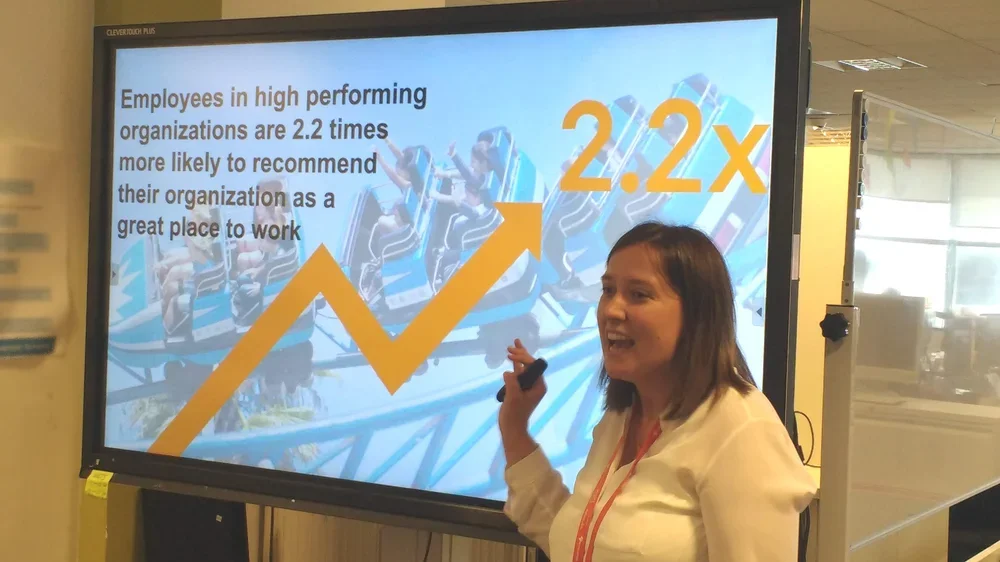
Annie Lloyd, Deloitte - presenting at the Engineering Guild on ways of working
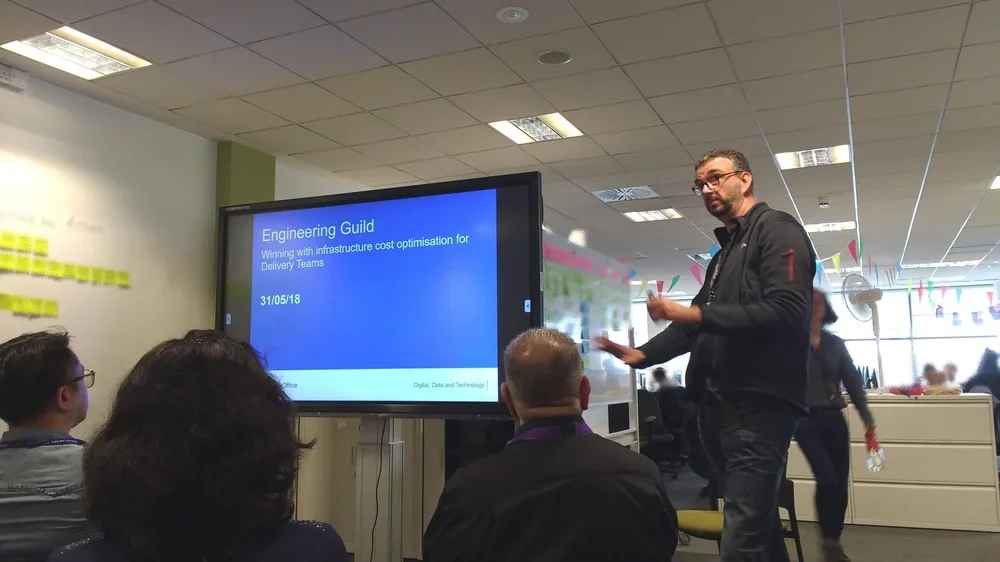
Andy Astley - presenting at the Engineering Guild on cloud cost optimization
Crucially, this approach relied on spotlighting successful teams on an open stage. Highlighting high-performing teams created a behavioral magnet. Other delivery teams developed a healthy sense of 'friendly FOMO' (fear of missing out), a desire to adopt recommended standards so their work would be recognized across the department. To align incentives across commercial boundaries, participation in the Engineering Guild and sharing of reusable practices were integrated into external supplier balanced scorecards, turning commercial partners into active champions of organizational capability.
Cross-team capability assessments: data paired with cultural pull
To provide executive leadership with visibility into engineering maturity while supporting team autonomy, we implemented a Multi-Team Capability Assessment (MTCA) framework.
In traditional enterprise transformations, engineering assessments are frequently feared as punitive auditing tools, prompting teams to game metrics. To prevent this negative dynamic, the MTCA framework was designed for self-assessment and data anonymization at the macro-level. Teams used the framework to evaluate their capabilities across multiple dimensions including continuous delivery, test automation, software operability, and team architecture.
Because the assessment process was decoupled from punitive management oversight and tightly integrated with the Engineering Guild's cultural pull, teams viewed the framework as a constructive tool for self-improvement. Assessment data highlighted capability gaps, guiding central enablement efforts toward the areas of greatest need.
Furthermore, teams that scored highly in specific maturity dimensions routinely volunteered to present their approaches at Guild sessions. This created a virtuous flywheel: quantitative capability assessments identified leading practices, which were then spotlighted through the Guild, driving voluntary adoption across the rest of the organization.
Measurable outcomes and strategic takeaways
The collaborative transformation delivered by Conflux and Axiologik produced dramatic, quantifiable improvements in organizational performance across the Immigration Technology Portfolio:
30% Efficiency Savings: Achieved across the portfolio's largest programme through the elimination of redundant work, streamlined handoffs, and standardized release procedures.
400% Increase in Software Delivery Capability: Demonstrated on the portfolio's core product, enabling faster, more predictable feature deployment and rapid response to critical policy changes.
Cultural Shift: Transformed multi-supplier dynamics into a unified community of practice focused on continuous improvement, shared standards, and humane engineering leadership.
For technical leaders navigating complex enterprise transformations, the Home Office case study highlights a vital lesson: sustainable delivery uplift cannot be commanded through top-down mandates. Real capability emerges when organizations combine small, essential mandatory standards with Active Knowledge Diffusion, non-punitive capability assessments, and a relentless focus on Continuous Delivery principles.
Further reading:
Read more: GOV.UK Home Office Adapt Together case study online https://adapttogether.info/all-case-studies/govuk-home-office
Moving towards Continuous Delivery at DDaT https://hodigital.blog.gov.uk/2018/08/10/moving-towards-continuous-delivery-in-ddat/